Dorothy Day & Non-Violent Resistance To State Violence


A Life of Peaceful Resistance

Dorothy Day’s approach to peaceful resistance was distinctive because it joined radical social activism, Christian anarchism and absolute pacifism. As co founder of the Catholic Worker Movement in 1933, she saw resistance not simply as protest or political strategy, but as a complete way of life. For Day, belief and action had to be inseparable.

The Foundations of Anti Nuclear Protest

Her principles directly shaped modern non violent protest and helped lay the foundations for the anti nuclear weapons movement. After the United States dropped atomic bombs on Hiroshima and Nagasaki in 1945, Day was among the few public religious figures to condemn the action immediately and unequivocally. She saw nuclear weapons as the ultimate expression of state violence, mechanised murder and the denial of human dignity.

Holy Disobedience

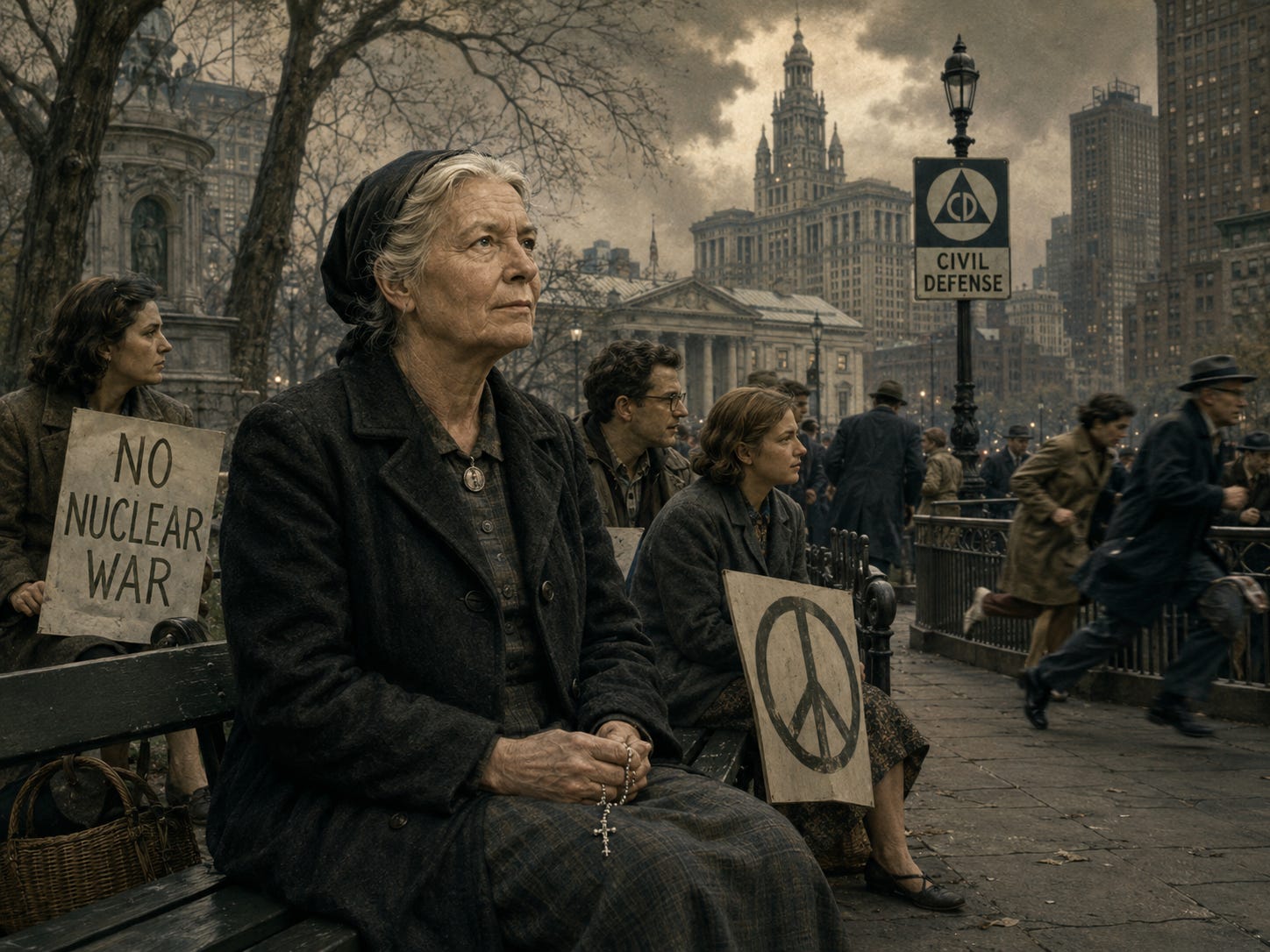
Day’s anti nuclear resistance was rooted in what she called holy disobedience. From 1955, New York State required citizens to take shelter during annual simulated nuclear attack drills. These drills were intended to train public obedience and suggest that nuclear war could be survived. Day rejected this logic. She argued that taking cover meant giving passive consent to the growth of nuclear arsenals and pretending there could be a defence against atomic war.

Refusing to Hide

In response, Day and a small group of pacifists refused to hide. They sat openly in City Hall Park while the sirens sounded. This quiet, visible act of non violent defiance forced the state to confront peaceful religious workers and elderly women with arrest and imprisonment. Day was jailed in 1955 and returned each year until 1961. Over time, the protest grew from a small group into a movement of students, mothers and ordinary citizens. By 1962, public non compliance had become so widespread that the compulsory drills were abandoned. Her actions showed that disciplined, repeated non violent resistance could weaken state enforcement.

Nuclear Weapons and Economic Injustice

Day also linked nuclear weapons to economic injustice. She argued that money spent on weapons of mass destruction was taken from the poor, meaning people were harmed before any bomb was dropped. Her witness later inspired Catholic and secular anti nuclear activists, including the Plowshares Movement of the 1980s, which used non violent direct action to disrupt military sites and symbolically damage nuclear equipment. Day showed that non violence was not passive. It required actively resisting the state’s preparation for mass death.

The Mystical Body of Christ

At the heart of her philosophy was the Christian belief in the Mystical Body of Christ. Day believed all people were spiritually connected, so harming another person, whether an enemy, opponent or marginalised individual, meant harming Christ and oneself. This made her pacifism absolute. She refused to support any war, including the Second World War and the Cold War, because she believed mass violence could never be reconciled with Christian love.

Personal Responsibility and Personalism

This belief was closely tied to personalism, the idea that each person has a direct moral duty to respond to injustice rather than waiting for governments or institutions to act. Day distrusted centralised power, seeing both corporate capitalism and state socialism as dehumanising systems. True resistance, for her, meant taking responsibility for one’s neighbour. If someone was hungry, you fed them. If a law was unjust, you disobeyed it.

The Works of Mercy

This responsibility was lived through the works of mercy, including feeding the hungry, sheltering the homeless and visiting prisoners. While many political movements focused on gaining power or changing laws, Day made hospitality her central form of resistance. Catholic Worker houses placed organisers in community with the poor, creating small examples of a new society within the old one. These houses challenged a profit driven economy by building communities based on solidarity, simplicity and love.

Voluntary Poverty

Day also believed that people could not resist an unjust economic system while remaining attached to its rewards. Through voluntary poverty, she and her fellow workers rejected consumerism, corporate greed and the military industrial economy. This allowed them to stand with the dispossessed not from a position of detached charity, but from shared reality.

Civil Disobedience as Witness

When secular law conflicted with conscience and the law of love, Day believed civil disobedience was a moral duty. She was arrested many times for placing her body in the path of injustice. Whether resisting nuclear drills, supporting striking workers, standing with farmworkers or campaigning for civil rights, she saw imprisonment not as failure, but as part of her witness.

Conclusion

Ultimately, Dorothy Day showed that resisting structural violence means more than opposing war. It requires the daily practice of compassion, community, courage and reverence for the dignity of every human soul.

Coming Home to the Self: How Internal Family Systems Therapy Helps Us Heal the Parts Within


Many people come to therapy feeling divided inside. One part of them longs for change, while another part feels frightened of it. One part wants closeness, while another pushes people away. One part carries shame, while another works hard to keep everything looking strong and capable. This inner complexity is not a sign that something is wrong with us. It is a sign that we are human.

A Compassionate Way of Understanding Ourselves

Internal Family Systems Therapy offers a compassionate and hopeful way of understanding this inner world. Rather than seeing anxiety, anger, avoidance, people pleasing, self criticism, addiction, numbness or despair as enemies to be defeated, it asks a different question. What if these experiences are parts of us that have been trying to help, protect or survive in the only ways they knew how?

This is one of the great gifts of Internal Family Systems. It does not begin with judgement. It begins with curiosity. It does not ask, “What is wrong with me?” It gently asks, “What has happened inside me, and what are my parts trying to protect?”

The Self as the Centre of Healing

At the heart of Internal Family Systems is the idea of the Self. The Self is not another part of us. It is the deeper centre of awareness, compassion and wisdom within the person. Some people understand the Self psychologically, as the calm observing centre of the mind. Others experience it spiritually, as the soul, the divine spark, the image of God, or the place within us where love and wisdom are not destroyed by suffering. However it is understood, the Self is the inner capacity to meet ourselves with mercy.

In Internal Family Systems, healing happens when our parts are no longer left alone with their burdens. Instead, they are met by the Self with calmness, curiosity and compassion. Parts that have carried fear, shame, grief, rage or loneliness can begin to trust that they no longer have to hold everything by themselves.

The 8 Cs and 5 Ps of Self Energy

The qualities of Self energy are often described through the 8 Cs and the 5 Ps. These are not moral achievements or spiritual badges. They are signs that we are becoming less overwhelmed by our wounded or protective parts, and more able to relate to them from a deeper place of steadiness and care.

The 8 Cs

calmness

curiosity

compassion

confidence

courage

clarity

creativity and

connectedness.

These qualities are deeply healing because they change the inner atmosphere. A distressed part that has been met for years with fear, judgement or suppression may soften when it is finally approached with gentleness.

Calmness

Calmness helps the nervous system settle. When we are blended with a frightened or ashamed part, it can feel as though the whole of us is anxious, defective or unsafe. Calmness creates space. It allows us to pause, breathe and notice that something is happening inside us, rather than believing that the distress is the whole truth of who we are.

Curiosity

Curiosity opens the door to healing. Instead of attacking a part for being angry, controlling, avoidant or self critical, curiosity asks what that part is trying to do for us. Very often, the parts we dislike most are parts that have worked hardest to protect us from pain. They may use old strategies, but their deeper intention is often protective.

Compassion

Compassion is central. Many people are frightened that if they show compassion to a difficult part, they will be excusing harmful behaviour or giving up responsibility. Internal Family Systems understands compassion differently. Compassion is not indulgence. It is the clear and warm recognition that every part has a story. Even the parts that create problems usually began as attempts to help us survive something painful.

Confidence

Confidence grows when a person discovers that they can be with difficult feelings without being destroyed by them. The therapist helps the client notice that there is a deeper capacity within them that can listen, witness and lead. This can be profoundly empowering for people who have felt dominated by fear, shame or trauma.

Courage

Courage allows a person to turn gently towards what has been avoided. This does not mean forcing trauma material or pushing past protective parts. True courage in Internal Family Systems is patient and respectful. It means being willing to listen when a part is ready, and being willing to stop when a part says it is not yet safe.

Clarity

Clarity helps a person separate their identity from the state they are in. There is a great difference between saying, “I am hopeless,” and saying, “A part of me feels hopeless.” The first statement can feel like a prison. The second creates space. It allows the person to recognise that hopelessness is present, but it is not the whole of who they are.

Creativity

Creativity allows new possibilities to emerge. A part that has spent years managing life through control, withdrawal, perfectionism or emotional shutdown may discover that it no longer has to perform the same role in the same exhausting way. When parts feel heard and understood, the whole inner system can become more flexible.

Connectedness

Connectedness restores relationship. Trauma often fragments us. It can leave parts of us isolated, frozen in the past, or hidden away in shame. As parts are welcomed back into relationship with the Self, the person may begin to feel less divided inside. This inner connectedness can also make outer relationships feel safer and more authentic.

The 5 Ps of the Therapeutic Process

Alongside the 8 Cs, the 5 Ps describe other qualities that support the therapeutic process:

presence

patience

persistence

perspective and

playfulness.

Presence

Presence means being fully with what is showing up. Many people have spent years trying to get rid of their pain. Internal Family Systems invites a different posture. Rather than rejecting the part, we turn towards it and say, in effect, “I am here. I am listening. I want to understand.”

Patience

Patience is essential because protective parts often do not trust quickly. This is especially true for people who have experienced trauma, betrayal, neglect, spiritual abuse or repeated disappointment. A part that has protected the person for many years may not immediately believe that it is safe to step back. It needs time. It needs consistency. It needs to know that it will not be shamed or forced.

Persistence

Persistence means staying gently committed to the process. Healing often happens slowly and in layers. Some parts need to be visited many times before they feel safe enough to reveal what they are carrying. Persistence is not pressure. It is faithful inner companionship.

Perspective

Perspective helps the person see beyond one part’s story. When a distressed part is blended, it can feel as though its view is the only truth. A fearful part may say, “Nothing is safe.” An ashamed part may say, “I am bad.” A protective part may say, “Never trust anyone.” Perspective allows the person to honour the part’s experience while also recognising that there is a larger truth.

Playfulness

Playfulness may sound surprising in therapy, especially when people are dealing with trauma or grief, but it can be deeply healing. Playfulness brings lightness, imagination and flexibility. It reminds the inner system that life is not only survival. There can also be warmth, humour, movement and hope.

Meeting a Part Through the 6 Fs

In a therapy session, the Internal Family Systems therapist may help the client explore a part through what are often called the 6 Fs. These are:

find

focus

flesh out

feel toward

befriend and

fear.

This is not a mechanical technique. It is a compassionate way of making contact with the inner life.

Find

First, the client is helped to find the part. This might be a feeling in the chest, a tightness in the stomach, a thought, an image, an impulse, a memory or an inner voice. Parts often communicate through the body before they communicate through words.

Focus

Then the client is invited to focus on the part. This means gently bringing attention to it. Where is it felt? What is its energy like? Does it have an image, a shape, an age, a posture or a mood? The aim is not to analyse from a distance, but to begin a relationship.

Flesh Out

The therapist may then help the client flesh out the part. What does it want the client to notice? What emotions does it carry? What does it seem to believe? What role has it been playing in the person’s life? A self critical part, for example, may reveal that it has been trying to prevent rejection by making the person perfect. An avoidant part may reveal that it is trying to prevent overwhelm. An angry part may be guarding a much younger wound.

Feel Toward

The therapist then asks a crucial question. How do you feel towards this part? This question matters because it shows whether the person is relating from Self energy or whether another part has blended with them. If the client feels curious, compassionate or open, there may be enough Self energy to continue. If the client feels hatred, disgust, fear or impatience towards the part, that feeling is itself another part that needs attention.

Befriend

Befriending the part means building trust. The client may ask the part what its job is, what it is trying to protect, and what it wants the client to know. This can be very moving. Many people discover that the parts they have hated or feared were carrying loyalty, vigilance and pain.

Fear

Finally, the therapist gently explores the part’s fear. What is it afraid would happen if it stopped doing its job? This question often reveals the protective purpose of the part. A part may fear that the person would collapse, be abandoned, be harmed, be humiliated, lose control, or be overwhelmed by grief. Once this fear is understood, the part no longer has to be treated as an enemy. It can be honoured as a protector.

Understanding Burdens

Internal Family Systems also speaks of burdens. A burden is the pain, belief, emotion or energy that a part has been carrying. These burdens may come from trauma, family patterns, childhood wounds, shame, loss, rejection or fear. A young part may carry the burden of believing, “I am not lovable.” A protective part may carry the burden of believing, “I must control everything or we will not survive.”

Legacy Burdens and Inherited Pain

Some burdens are personal. Others are legacy burdens. Legacy burdens are the emotional and spiritual inheritances that pass through families, communities, cultures and histories. These may include shame, silence, fear, violence, religious terror, racial trauma, class humiliation, gendered expectations, exile, poverty, addiction or unresolved grief. Sometimes a person finds that they are not only carrying their own pain, but also the unspoken pain of those who came before them.

This is where Internal Family Systems can become deeply liberating. It helps a person recognise that not everything inside them began with them. Some burdens were inherited. Some were absorbed from the family atmosphere. Some were passed down through culture, religion or history. Naming this does not remove responsibility for our lives, but it does bring mercy. It allows us to say, “This pain is real, but it is not the whole of me. It may have come through me, but it does not have to continue through me.”

The Spiritual Dimension of Healing

The spiritual dimension of this work can be profound. Many spiritual traditions teach that beneath fear, shame and fragmentation there is a deeper wholeness. Christianity speaks of the image of God within the human person. Mystical traditions speak of the soul’s return to love. Buddhism speaks of compassion and awareness. Many wisdom paths recognise that the deepest healing is not achieved by hatred of the self, but by a loving encounter with what has been exiled.

Internal Family Systems offers a language that can sit gently alongside this spiritual wisdom. It suggests that there are no bad parts. There are wounded parts, protective parts, frightened parts and extreme parts, but beneath them all there is a deeper Self that can lead with love. For a spiritually minded person, this Self may feel like the place where grace can be received. It may feel like the inner sanctuary where God meets the person without condemnation. It may feel like the divine spark that has never been extinguished, even by trauma.

Healing the Whole Person

This does not mean that therapy becomes religious. It means that healing can honour the whole person. For some, the work remains psychological. For others, it becomes prayerful, contemplative or sacred. A part that has carried shame may need not only understanding, but mercy. A part that has carried fear may need not only reassurance, but blessing. A legacy burden may need not only insight, but release.

In this sense, Internal Family Systems can help people move from inner exile to inner reconciliation. It can help the person become a compassionate witness to their own story. It can help protective parts relax, wounded parts be heard, and burdened parts discover that the past does not have to remain alive in the same way inside the present.

Coming Home

The aim is not to become perfect. The aim is to become more whole. The aim is not to silence parts, but to listen to them. The aim is not to control the inner system through force, but to allow the Self to lead with calmness, courage, clarity and compassion.

Many people have been taught to treat their inner life as a battlefield. Internal Family Systems offers another image. The inner life can become a place of healing relationship. The parts of us that once seemed troublesome, shameful or frightening can be understood as carrying stories that need to be heard. When they are met by Self energy, they may begin to release the burdens they were never meant to carry forever.

This is the heart of the work. We do not heal by abandoning parts of ourselves. We heal by turning towards them with love, truth and patience. We heal by discovering that beneath the noise of fear and protection, there is a deeper centre within us that already knows how to welcome, witness and restore.

In spiritual language, this may be described as grace moving through the inner system. In psychological language, it may be described as integration. In ordinary human language, it may simply be called coming home.
Averting Global Disaster: A New Consciousness of Compassion

The Digital Narcotic and the Great Detox

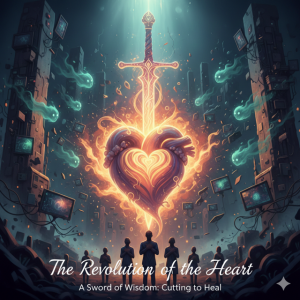
A surreal digital artwork featuring a glowing, fiery heart at the center, pierced by a luminous sword of light. In the background, dark, crumbling monoliths and distorted TV screens represent a collapsing system, while small, spectral figures float away. At the bottom, a group of people stand in quiet, centered presence.

We are living in an age of manufactured noise, where the screens in our pockets act as spiritual narcotics, designed to keep us reactive rather than reachful. But beneath the crumbling institutions and the media spin, a deeper detoxification is happening. To survive the collapse of the old systems, we must trade our outrage for a revolution of the heart.

We need compassionate grace to immerse ourselves in the suffering of the world, bringing with us our healing wisdom and presence. These are the qualities of soul the world currently demands.

The problem with the manipulative media spin on our screens is that it is designed to keep us disengaged from the very things we have the power to change. Mainstream media feeds us a narrative intended primarily to sustain its own existence. To counter this, we must view all media through a filter of compassionate detachment. This allows us to read the subtext and discern truth from the spin.

We witnessed thousands of innocent lives, including many children, lost in Gaza—massacred by a supply of Western weapons fueling a cruel regime. Yet, the mainstream media downplayed the horror, aligning with political messages that diminished this reality. Can we truly trust such a source?

We know little of the truth within the institutions of power, privilege, and corruption, receiving only enough soundbites and “breaking news” to keep us in a state of reaction. We are being emotionally buffeted by algorithms—the modern spiritual narcotic.

However, these systems of power are slowly disintegrating, detoxifying from the inside out through a shift in consciousness deeper than we can imagine. The performers on the political stage are being exposed as compromised; the tech elites puppeteering the system are revealing their sociopathy. Even the wealthy are building bunkers, sensing the game is reaching a critical point.

Now, more than ever, we need courage, resilience, and discernment. A “revolution of the heart” must guide our actions. Our conscious presence alone is alchemizing. There are “mind parasites” in this realm that feed on fear and despair, leaving us drained. But a compassionate revolution does not require these low-vibration emotions. Anger guided by love does not spring from media-driven outrage; it arises from witnessing suffering. It is a sword of wisdom that cuts only to heal.

Do not let the ‘mind parasites’ of despair claim your energy today. Instead, choose one area where you can bring your conscious presence—whether it is a conversation, a cause, or a moment of stillness—and show up with the strength of a heart guided by love. The world doesn’t need more noise; it needs your healing wisdom. How will you show up today

A New Dawn of Compassion: Transforming the Darkness of Our Time

A New Dawn of Compassion: Transforming the Darkness of Our Time

Beyond Fear and Greed: A Call to Awaken Human Consciousness

Listening to the Pain of the World: Healing the Human Soul

My heart is listening to the pain of the world. There is so much anger, fear, suspicion, projection, despair, violence, grief, sadness, and mistrust. We live in a time when trustworthy leaders are almost nowhere to be found. Some are dictators. Others are neoliberal mouthpieces. Many are corrupt, serving the interests of billionaires and corporate lobbyists. Politics has become a theatre of self-aggrandising agendas, ambitious posturing, and empty promises—while children go hungry and families live under clouds of uncertainty.

How did we arrive at a moment when our governments are filled with people so disconnected from their own souls that they can no longer empathise with human tragedy, pain, or suffering?

Most people simply want a reasonable life: decent pay, affordable food, secure housing, healthcare, and good education for their children. Most people are willing to play their part in creating a sustainable world built on connection, relationship, interdependence, and community. They do not want wars, dictatorships, violent invasions, or domination.

Yet, the geopolitical crisis we now face is not the result of one leader, party, or ideology. It is the product of an intricate web of psychosocial and psychospiritual forces shaping our collective order—forces that, while complex on the surface, stem from a deeper spiritual pathology.

A good place to begin understanding this is with the small but powerful minority who have gained overwhelming influence over governments, technology, and global policymaking. Their unchecked power is pushing our world toward self-destruction in pursuit of ever-greater wealth, control, and resources. This is no longer a conspiracy theory—it is happening in plain sight. Their greed is underpinned by a cold contempt for ordinary humanity, one that has made life for millions harsher, lonelier, and more desperate.

Author and spiritual teacher Paul Levy describes this dark influence as Wetiko—an ancient psychospiritual contagion residing in the collective consciousness of humanity. According to Levy, Wetiko acts like a virus of the mind, amplifying selfishness, corruption, violence, and ignorance. It manipulates us into collective blindness, cutting us off from our divine nature. True freedom, he argues, comes from recognising and healing our susceptibility to Wetiko, which awakens us to a higher level of consciousness.

Greed and avarice have become the engines of the modern world order, impoverishing both material and spiritual life. Yet we are capable of so much more than what our systems of government, commerce, and religion tell us. We are, in essence, luminous beings—souls divinised by the light of grace.

Our true identity has been deliberately obscured by both human and nonhuman forces. Throughout history, humanity has shown its paradoxical nature: capable of both brutal tribalism and transcendent compassion. Alongside fear and scarcity, there have always been acts of deep altruism, empathy, and self-sacrifice.

We have seen individuals whose awakened consciousness changed the course of history: Martin Luther King Jr., Thích Nhat Hạnh, Rosa Parks, Marie Curie, Nelson Mandela, Harriet Tubman, Emmeline Pankhurst, Maya Angelou, Malala Yousafzai, and countless others whose names never reached fame.

Even in the dark days of segregation, young women like Joan Trumpauer Mulholland, Ann Braden, Sandra Hayden, and Constance Curry risked everything to resist injustice. They were ordinary people whose crises became catalysts for divine awakening. Their lives remind us that the light of higher consciousness is not reserved for saints, but lives within us all.

We may never be called to heroic sacrifice, but we are, every day, invited to express our truest nature in small yet sacred ways. As Teilhard de Chardin described, humanity is part of a vast noosphere—a shared field of consciousness. Every act of goodness ripples through this network, evolving both humanity and the planet toward its divine potential.

At the heart of this evolution lies compassion—a quality with exponential power to awaken higher consciousness. Compassion is the recognition of suffering, joined with the will to alleviate it. It unites empathy with courage, wisdom with tenderness. When cultivated intentionally, compassion becomes a radiant contagion, an antidote to Wetiko.

This was the power that Martin Luther King Jr. and others channeled in their movements of peaceful resistance. Through love and compassion, they dismantled systems of hatred more effectively than violence ever could.

I believe that humanity has long been manipulated to act from fear and division by unseen forces seeking our downfall. But I also believe that we now stand at the threshold of transformation—a shift in global consciousness that could redirect us from the brink of self-destruction.

Amid today’s chaos, the cure is already within us. It begins by acknowledging and befriending the shadow parts of our psyche—the places where Wetiko hides. With compassion as our guide, we can journey through this inner darkness without shame or fear. Compassion steadies the ego, reminding us that we are not our wounds, not our mistakes, not our despair.

Our true identity has never been touched by evil. It remains whole, luminous, and divine—and it is calling us home.

Francis: An Icon of True Humanity

St Francis’ lasting legacy was to teach humanity the sacred lessons of unconditional and boundless love. He especially taught love through his humble service to the vulnerable peoples in his own time who were held in contempt by the powerful and comfortable. He demonstrated the indestructible power of love, which overcomes our primal egoic thoughts of fear and separation, when he conquered his revulsion and fear of leprosy, kissing and embracing a leper. He then dedicated his life to the service of this most vulnerable, outcast and reviled community of his age. His freedom to undertake this service of love so powerfully was inextricably linked to his detachment from worrying about what others thought about him. This was an incredible freedom.

Francis radical non attachment to material possessions of the world was an antidote against the manipulation and control agenda of the world expressed in the cultural norms of his society. He was an advanced being of divinity and light who came into the world to change the course of the world for centuries beyond his own age. He is especially relevant to the world of today which sits on a dangerous precipice. This is why Francis appeals to people’s of all spiritual traditions and none. His message is that of non-partisan love. He demonstrated to us all how the living Christ present in all living beings, can be activated and actualised in a single lifetime.

Francis exuded light. He was consciously united with Eternal Light and this light shone on all whom he encountered. This Divine Light dwells within each one of us, and which is our deepest true self (but which is dormant in most of us). He was a mystic, healer, teacher, Bodhisattva and a dear father to the despised and disposable of his society. Francis is an icon of our own journey towards illumination. He is a pointer to our spiritual awakening. When we heal from our internal fear, judgment, harshness and violent self-criticism and embrace simplicity of heart we strip away the ego and superego, and fear-based defences such as cynicism, pessimism, chauvinism and narcissism. When we become light we warm and illuminate the lives of others. Francis can be a dear companion to us on the journey, gently helping us to deconstruct the unreal to reveal the real. Allow him to draw close to you.

The Symbolic Journey of St Teresa’s Interior Castle

 
The 15th century mystic, Teresa of Avila, loved the usage of archetypal symbolism and metaphor in her writings to describe her understanding about the nature of the divine, the state of heaven, the substance of the soul and the stages of the spiritual life. The Interior Castle was one of her finest teachings on the nature of the soul and prayer and is beautifully written in symbolic language. Of this interior castle, Teresa wrote:
 
I began to think of the soul as if it were a castle made of a single diamond or of very clear crystal, in which there are many rooms, just as in Heaven there are many mansions.1
 
She described the crystalline image of the soul as consisting of seven domains or mansions which define developmental points of growth for the soul in the process of spiritual evolution. This evolution is the souls’ movement towards deeper union with God. The soul which has reached the first mansion is in the earliest developmental stages of the spiritual life.
 
It is important to note that developmental stages are a helpful metaphor for broadly describing something of our reaching particular milestones or goals in the psychological or spiritual life. However, the experience of deeper union with the Divine is not a linear process. Human beings often learn and grow through patterns of circularity rather than in a linear manner. People often repeat and revisit life-lessons and experiences several times over before fully integrating them into the psyche.
 
The metaphorical journey into God doesn’t presuppose that there is an absence of God within the human soul which we somehow correct by the efforts of the ego, which is incapable of undertaking such an endeavour. As Julian of Norwich reminds us, the soul was created out of the substance of God, bearing within itself the divine image. We are, as Thomas Merton said, shining more brightly than the Sun. We are inseparable from our Source, though we might experience ourselves as separate. As St Catherine of Sienna said:
 
The soul is in God and God in the soul.
 
Although the Interior Castle is Teresa’s narrative of the soul’s journey of growth and maturation in God – even with the divine journeying with the soul into the purifying experience of painful darkness – it is a love story between us and divinity. God pursues the soul and gifts it with divine love; with an experience of oneness and unity with God. It is not our effort but God’s graciousness -with a little willingness and perseverance from us- that effects the complete experience of union.
 
In the Teresian language of the Interior Castle, the First Mansion is considered to be the furthest dwelling place away from the seventh dwelling. According to Teresa, the soul experiences a sense of full unification with the divine in the seventh mansion. Each mansion between the first and the seventh describe something of our progressive growth into the love and mystery of the divine.
 
In this first mansion Teresa considers the soul as still dwelling very much in the superficial realm of life, overly concerned with the ephemeral though possessing some desire to find a way forward in the spiritual life. Teresa recognises that through grace the person who has entered the first mansion has the desire for the spiritual life but they are still neophytes and they are easily susceptible to self-doubt and fear. She refers to these influences as being like reptiles that bite at the resilience of the soul. For Teresa, the importance of the cultivation of the spiritual life helps us to build spiritual resilience in the first mansion in order to progress forward into deeper union with the indwelling divine presence. Patience, dedication and self-compassion are important qualities to cultivate in building our resolve to make this inner journey, knowing that this journey is our birth right to undertake. And we need to remember that we are creatures of circularity, insofar as we move around and between these metaphorical mansions (backwards and forwards too) reinforcing our learning, and developing familiarity with our mind and emotions and how they operate.
 
Each movement through the mansions would indicate an increasing level of spiritual consciousness in which the influences of the individual ego and the challenges of life-circumstances decrease in strength against our endeavours, resulting in a gradual increase in the souls’ resilience and experience of divine consciousness.
 
1 Teresa of Avila. Interior Castle. Ed. and Trans. E. Allison Peers. New York: Dover Publication, 2007.
2 Catherine, of Siena, Saint, 1347-1380. (1907). The dialogue of the seraphic virgin, Catherine of Siena : dictated by her, while in a state of ecstasy, to her secretaries, and completed in the year of our Lord 1370; together with an account of her death by an eye-witness. London :K. Paul, Trench, Trübner,

The Cathars of Languedoc: The Blooming of The Laurel

 
Originally written for the Lynn News, Thought for the Day
 
The Cathars of Languedoc were a group of medieval Christians who have been very close to my heart since I first learned of them in 2011. The Cathars were called the good people by friends and neighbours. They were a Gnostic Christian community who lived in the South of France in the 12th century. Cathars were divided into two groups: the parfait (perfected) who were men and women who lived a strict life of simplicity, celibacy, prayer and vegetarianism and leading activities of worship and faith. Men and women were equals in Catharism. The second group of Cathars were the ordinary followers who did marry, but attempted to live according to the Cathar ideals as best they could. Most, however, would usually wait until being close to death before committing to the rigors of becoming parfait. Becoming parfait happened through a ritual called the consolamentum.
 
My sense of closeness to this medieval group has grown considerably over the past few years, driven by a sense of sadness at witnessing the growing polarisations within our own society and the progressive breakdown of a palpable sense of interdependent community. The Cathars were able to be a community in a very real manner. I have deep respect for their commitment to peace at a time when war was bloody and unmerciful; for embracing simplicity, compassion and cohesion. They were respected and loved by their Catholic friends and neighbours, despite having very significant theological differences with them.
 
The Cathars loved their spiritual beliefs despite the growing threat to them from the increasing power of the Inquisition. The Cathars had not been silent in confronting the corruption of the medieval Church which made them especially vulnerable. Over a century, a million Cathar men, women and children were exterminated, many burned at the stake. The inquisition said of them the smallest trace of ‘sin’ had to be extirpated and the corrupt body had to be destroyed and evil exorcised in the flames.
 
On March 16, 1244, around 200 Cathar perfects at the Montségur Castle embraced death rather than renouncing their faith; murdered by the Inquisition, they faced death by fire.
 
On the 21st August 1321, Guillaume Belibaste, the last of the Parfait, was burnt at stake. While dying he proclaimed this prophecy of hope:
 
After 700 years, the Laurel will become green again on the ashes of the martyrs!
 
Those words were spoken 700 years ago. The awakening of consciousness he proclaimed is happening now.
 
My intention is to visit Montségur as a pilgrim in order to honour our martyred Cathar brothers and sisters, to especially pray for an end to war, violence, persecution and division on Earth, and for an increase in compassionate, resilient communities to flourish and spread the fragrance of loving-kindness. At this moment I send my prayers of peace to Israel, Gaza, Ukraine, Afghanistan, Syria, Yemen, Iran, Myanmar and all places where there is conflict. I pray for the victims of trafficking, modern day slavery and violence; for all children hurt and abused, for all refugees and migrants. My hope is we bring them all into safe, loving and resilient communities where they can heal and recover from trauma and loss.

The Gift of Mindfulness for You

Mindfulness is a form of meditative practice which focuses upon our mind and attention. In Mindfulness we notice bodily experiences, such as our breathing, sensation, and our energy. We notice external things such as sounds near to us, smells, taste and touch. Mindfulness draws upon a knowledge base of cognitive behavioural psychology, neuroscience, and Buddhist philosophy and psychology

Mindfulness draws our attention to the fluctuating nature of the mind with its many thoughts, ideas and images that flit across our awareness. In mindfulness we notice thoughts, perceptions, feelings, reactions and emotions but we do not identify with them as the self, but recognise them just for what they are; hectic intrapsychic activity. The hopeful fruits of mindfulness for our lives through our focus on the here and now, in the present moment, is to help us to be more aware generally in our lives of the beautiful things we might miss in the morass of our many thoughts, e.g., the beauty of a sunset or sunrise; the scents of nature, or the delicious taste of something we are eating or drinking. The busyness of our mind and its many thoughts and distractions can draw us away from joy and peacefulness, right here and right now.

Busy and habitual thinking can make us lose contact with our bodily sensations. which are an important anchoring in life in the present moment. Through noticing our senses such as vision, hearing, olfactory senses, taste and touch, we can enjoy our senses more profoundly.

There are nine attitudes of mindfulness based upon Jon Kabat Zinn’s original 7 attitudes of mindfulness: beginners mind; non-judgement; trust; letting go; non-striving; acceptance; patience; gratitude and generosity.

Beginner’s mind – witnessing the present moment with the mind and eyes of a beginner. In terms of mindfulness this might be recognizing the flow of thoughts that pass through our mind, the judgements that arise within us or our conditioned reactions, in relation to particular phenomena. Through noticing these mental and somatic reactions, we can choose not to give them central stage in formulating our perspective on our experience. The beginners mind might potentially make room for something new that might arise from our creativity; allowing ourselves to be surprised by this innate creativity. For example, if I bring a beginner’s mind to my role in my job, I might see ways of developing the role emerging with a fresh and creative perspective rather than using a mind conditioned by past, experiences and narratives which might limit my vision. This happened recently in some interfaith work I undertook as a chaplain in the hospice where I work. I outreached to the local Islamic community the week during the UK riots (August 2024) and came to this meeting and encounter with empty hands and an open heart, to listen, to try to understand and to allow this listening to enrich the conversation.

Non-judgement – in terms of mindfulness this is attempting to cultivate a mind that can look at a phenomenon or phenomena without being overly influenced by our mental or social conditioning. A mind which is non possessive, not driven by one interpretation or set of beliefs, nor driven by a desired outcome, and is willing to tolerate uncertainty, and be open to multiple possibilities, can approach life in creative ways and from a more compassionate position.

 Trust – In terms of mindfulness let’s remember, that when we sit in a chair, we don’t anticipate that the chair will collapse under us; when we walk on the pavement we trust that the ground under our feet will not suddenly give way and cause us to fall into a chasm. We trust that our heart will beat and our lungs will breathe. The quality of trust in terms of mindfulness practice is about cultivating a mindful sense of our ability to trust ourselves and life in a way that is similar to how we trust the chair or the ground. This trust is not done naively (e.g., if we noticed the chair had large cracks in the legs we wouldn’t sit down on it). It is not undertaken by refusing to listen to our natural fight, flight or freeze evolutionary capacities for detecting risk or danger and responding to it (e.g., not walking in proximity to an angry and vicious dog). Trust, however is attempted by witnessing, but not identifying with our conditioned memories, thoughts, feelings and responses from the past to our experience of witnessing. For example, if you have been let down in previous romantic relationships, this does not mean you can’t ever trust romantic relationships, but through mindfulness you can learn to trust the wisdom within you to help you to discern what can help you with trusting people with wisdom rather than falling prey to strategies of control. Trust is about becoming more in-tune with our creativity and intuition, which could be described as our hearts ability to wisely guide our mind through discernment.

Letting-go –  Mindfulness can help us to detach from ego driven over management of aspects of our lives (e.g., relationships, work, health, etc.,) in which we might have come to believe requires our absolute and dedicated control. This desire to control can often arise from previous adverse experiences in our lives such as a betrayal, abuse, a career loss, a divorce, a bereavement, and many other life events. The desire to control is understandable and definitely calls for mindful compassion; but controlling strategies are not something we want to determine our decisions or behaviour, now.

Non-striving: In terms of mindfulness, non-striving describes how we can become aware of our capacity to do life in terms of achieving, acquiring, attaining, succeeding, etc., Non striving invites us into the ground of being rather than doing (striving). Mindful non striving can create space for making room for deeper wisdom to arise by our slowing down and stopping. This can enhance our doing because it can potentially release our creativity, wisdom and deeper knowledge. I have heard it said that geniuses very often had their eureka moments, not in the laboratory but whilst in the shower or enjoying a cup of tea.

Acceptance – with respect to the mindfulness of acceptance this refers to a shift in perception from being overwhelmed by our resistance to what is happening in our lives, and gently allowing ourselves to accept that an issue for what it is, right now. Acceptance is not passive relinquishment of responsibility or action. If I needed to prepare myself for demanding and difficult experiences, a position of acceptance could help me to allow my mind to calm, and for my resilience, stamina and coping skills to come online.  

Patience – in terms of mindfulness, acceptance and non-striving are strongly linked to patience. Cultivating mindful patience can consist of accepting the reality of something in a given moment (e.g., a health, social or financial problem) and putting a pause on doing something immediately, and just allowing the issue to be for a while. Sometimes, (not always) remaining calm when events may seem to be in flux, and delaying wanting to react or act (i.e., immediately engaging with problem solving) can help me to be less stressed and overwhelmed (which might undermine my effectiveness needed with managing a phenomenon) possibly allowing more helpful perspectives to arise from wisdom. 

Gratitude – in terms of mindfulness, whatever problems we face in life, if the mind with which we are going to face these problems is dominated with thoughts of complaining and dissatisfaction, this will impact on our experience of these problems. These negative responses can ruin our potential for peacefulness and happiness. Gratitude in comparison is a mind-set that looks upon our lives in terms of what is good, helpful and fulfilling in our lives, which cultivates peace and balance. The mind when honed upon what is wrong, tends to exclude from our mind what is good and beautiful.  There is psychological and neuroscientific research into the benefits of cultivating gratitude for our lives which suggests many therapeutic benefits from cultivating gratitude such as peace of mind, greater stress reduction, increasing self-esteem, increased personal happiness, positive mind states and medical benefits such as lower blood pressure, better sleep, stronger immune system, etc. The research suggests positive neuroplasticity in terms of our brain wiring for happiness.

Generosity – in terms of mindfulness, generosity and compassion belong together in the same domain. Cultivating a generous, giving heart towards others, can make us experience ourselves in a positive and meaningful way. The golden rule from most religions and philosophies of life, is do unto to others as you would want to be done to you. What we do to others affect how we perceive ourselves. Our actions of generosity help define our attitudes towards ourselves and others. Grasping and over-attachment to impermanent things that will disintegrate are strongly linked to craving. Grasping can only be satisfied by the constancy of getting things and holding on to them. Generosity in contrast, is a quality of being that is lasting and takes joy in the happiness and fulfilment of others.

Embodiment of mindfulness is the goal of practice.

Embodiment is the result of embedding mindfulness practice into the very fabric of our lived existence and experience. Repetition of mindfulness practice is key. It must permeate every aspect of our lives, with our becoming a more mindful person. It is not the supplanting the person I am with a different identity. It is our leaning close to our deepest true self underpinned with the qualities of patience, compassion, cooperation and acceptance. Being mindful with humility, is what enables us to become authentic mindful practitioners, because we are in contact with who we truly are at the deepest level of our being. Professor Paul Gilbert identifies these deep qualities of being as emerging from our evolutionary development for survival which has helped humanity to survive as a species, especially through cultivating capacities for caring, attachment, cooperation, and extending warmth and protection to the vulnerable, especially children. This deep reservoir of our consciousness is capable of compassion, service, creativity, innovation and many other positive qualities of being. Not perfect, but imperfectly perfect.

The psychological wisdom drawn upon from ancient Buddhism to inform mindfulness practice are multi-form: (1) recognising the nature of suffering and the causes of suffering; (2) recognising there is a way to end suffering and the path that leads to the end of suffering; (3) the importance of mindful detachment; acceptance of the reality of the present moment; observing the nature of the mind and emotions and  understanding how the mind can be complex and tricky, etc. (4) practices such as loving kindness meditation and the cultivation of warm heartedness. All of these inform the nine attitudes of mindfulness: non-judging, patience, the beginner’s mind, trust, non-striving, acceptance, gratitude, generosity, and letting go.

The Importance of Meaning

 
Originally written for the Lynn News, Thought for the Day
 
Viktor Frankl was a Jewish psychiatrist and neurologist who was a survivor of the Nazi Holocaust. He spent three years in the infamous concentration camp, Auschwitz. This experience led him to write a transformative book called Man’s Search for Meaning. The book describes how finding deep meaning in his life, despite the horrors surrounding him, gave him the resilience to survive. Frankl later went on to found a school of psychotherapy called logotherapy, which helped patients transform their psychological suffering through developing a deep sense of meaning. He believed that meaning enhances our spirit and our will, to both survive and thrive. Frankl once said:
Everything can be taken from a man but one thing: the last of the human freedoms—to choose one’s attitude in any given set of circumstances, to choose one’s own way. When we are no longer able to change a situation, we are challenged to change ourselves.
For Frankl his source of meaning whilst in Auschwitz related to the completion of a manuscript that he had started before his internment. Meaning does not need to be anything grand or radical. It is most often related to the capacity of the human heart to care about something that is important to us. It might be about what we do for a living, a close relationship, our creativity, or anything that warms and inspires our heart. Maya Angelou, the Black American poet, political activist and writer, tells us that she suffered a terrible trauma in her childhood which stopped her from speaking from the age of 8 until she was 11. As a Black woman in the pre-Civil Rights era of the U.S., she was well acquainted with the experience of racism and sexism. In one of her most famous and profound poems Still I Rise, she says:
 
You may write me down in history
With your bitter, twisted lies,
You may trod me in the very dirt
But still, like dust, I’ll rise.
 
The poem continues to describe the reasons why Maya will rise from oppression. There is humour in this poem that weaves through the verses:
 
Does my sexiness upset you?
Does it come as a surprise
That I dance like I’ve got diamonds
At the meeting of my thighs?
Out of the huts of history’s shame
I rise
 
What gives you meaning in your life? Does it make you smile? Do you want to befriend it and hold it close? Whatever it is, your meaning is about your unique and precious self, held safe and nurtured as a citizen of the Cosmos.
Jesus once reassuringly told us:
 
In this world you will have trouble. But take heart! I have overcome the world.
 
The Buddha once advised us:
 
We are what we think…with our thoughts, we make the world.
 
Our capacity for thought, reason, reflection, story-telling and creation, borne from both our heart and mind, are our tools for creating meaning. Let our hearts and our thoughts, anchored in a deep and loving respect for ourselves and others, lead us to make deep meaning in our lives.